

For decades, The Devils was the Bigfoot of movies. Everybody had heard of it. Almost nobody had seen it.
I first read about it more than twenty years ago in a magazine called Bizarre, which ran lists of the most controversial films ever made. The Devils was always near the top. It was cut up, shelved and kept out of sight, and the version Ken Russell actually wanted people to see wasn't something you could just go watch. Now Warner Bros. Clockwork has put a 4K restoration of the director's cut into theaters, and I finally saw it the way it was meant to be seen.
It's almost a masterpiece. It's also hard to sit through. Both things are true.
A true story, and it shows
The film opens with a title card saying these accounts are known to be true in historical texts. It's based on Aldous Huxley's book The Devils of Loudun [AFFILIATE: The Devils of Loudun by Aldous Huxley, paperback or Kindle] and John Whiting's play adapted from it, and you can feel the stage in it. The performances are big, the staging is deliberate, and nobody is playing it small.
The setting is France in the reign of Louis XIII. The crown wants to knock down the walls of fortified towns and fold them into its power. Loudun is one of the best defended, and the man who runs it, in every way that counts, is Father Urbain Grandier. Oliver Reed plays him as a sexy, arrogant priest, and he's perfect. Reed was a madman off screen and an excellent actor on it, and pairing him with Ken Russell makes sense the second you see them work.
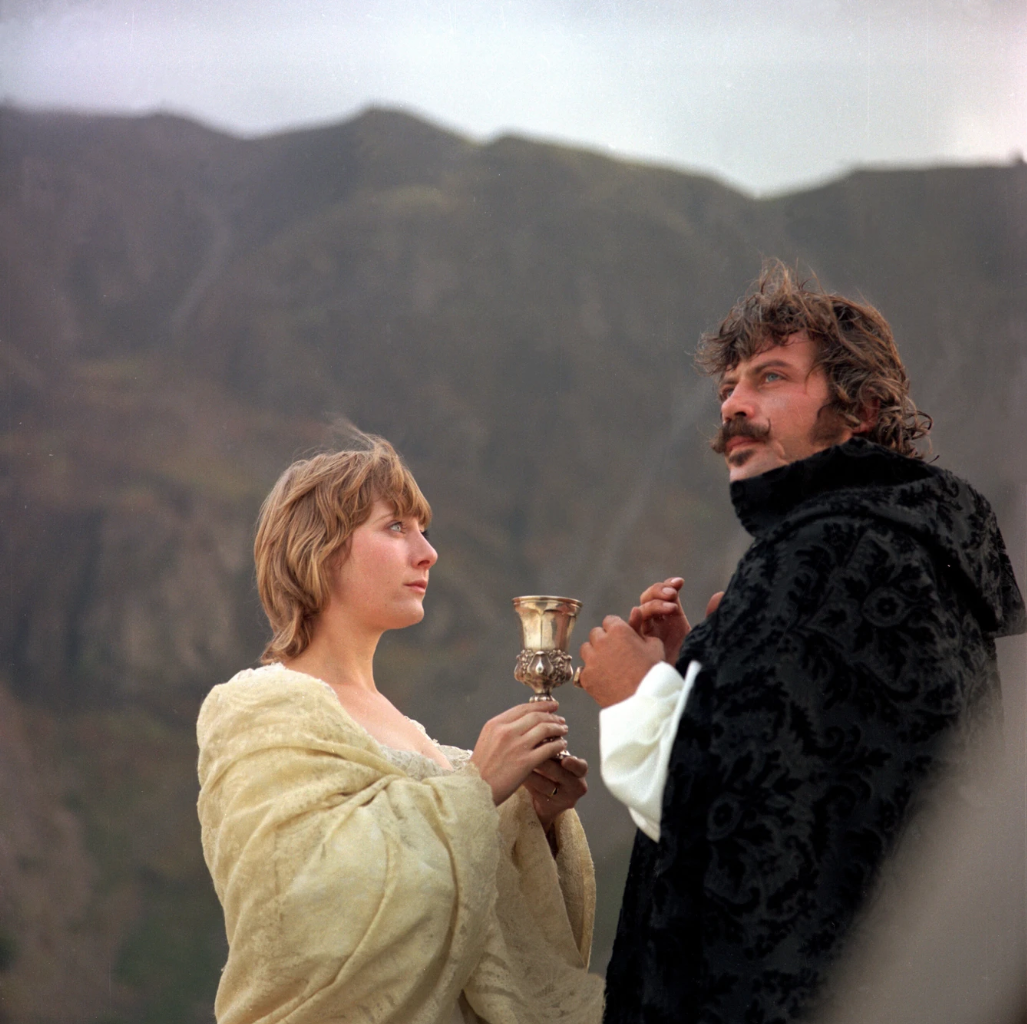
Oliver Reed as Urbain Grandier. Still from The Devils (1971), Warner Bros.
The crown's people zero in on Sister Jeanne, a hunchbacked nun played by Vanessa Redgrave who, like half the town, is obsessed with Grandier. She accuses him of witchcraft, and suddenly the devil is possessing every woman in Loudun. Grandier is away, having secretly married. He comes home to a town that has gone insane and decided it's his fault. They torture him. He refuses to confess to crimes he didn't commit. In the end they burn him, and they take the town.
Why it caused such a fuss
Once the "possession" spreads, the film turns into a wave of ecstatic, defiant, sexual behavior aimed straight at religious imagery. Images of Christ are defiled. There's a huge orgy sequence in a church. If you've seen Caligula, you'll recognize the territory, and Caligula came out eight years later.
What surprised me is that it isn't really gory, and it isn't shot to turn you on. It's transgressive in a way that gets under your skin, because everyone is manic and talking in this ludicrous heightened way. In 1971 that kind of attack on religion was close to unthinkable on a movie screen. You can see why it spent so long on the shelf.
The look of it
I'll say this plainly: it's the best-looking Ken Russell movie I've seen, and I've seen a lot of them.
The restoration helps. This one was done from the original camera negative, and the picture is spectacular. But the real credit goes to the design. Derek Jarman did the production design, and per the BFI this was his feature film debut. If you know Jarman only as the filmmaker who went on to direct music videos for The Smiths and Pet Shop Boys, go look at what he built here. The sets are stark, white and enormous, and the whole thing plays like an occult ritual staged in a cathedral that was never meant to exist. David Watkin's cinematography and Shirley Russell's costumes carry it the rest of the way.
Some images stuck with me for days. The young woman Grandier gets pregnant spends the entire film in what looks like clown makeup, and she still gets some of the most beautifully composed shots in it. There's a scene with two plague doctors, masks on, lit from below, looking like something out of a nightmare. More than once I caught myself thinking, this is a deeply strange movie and that is an awesome shot.
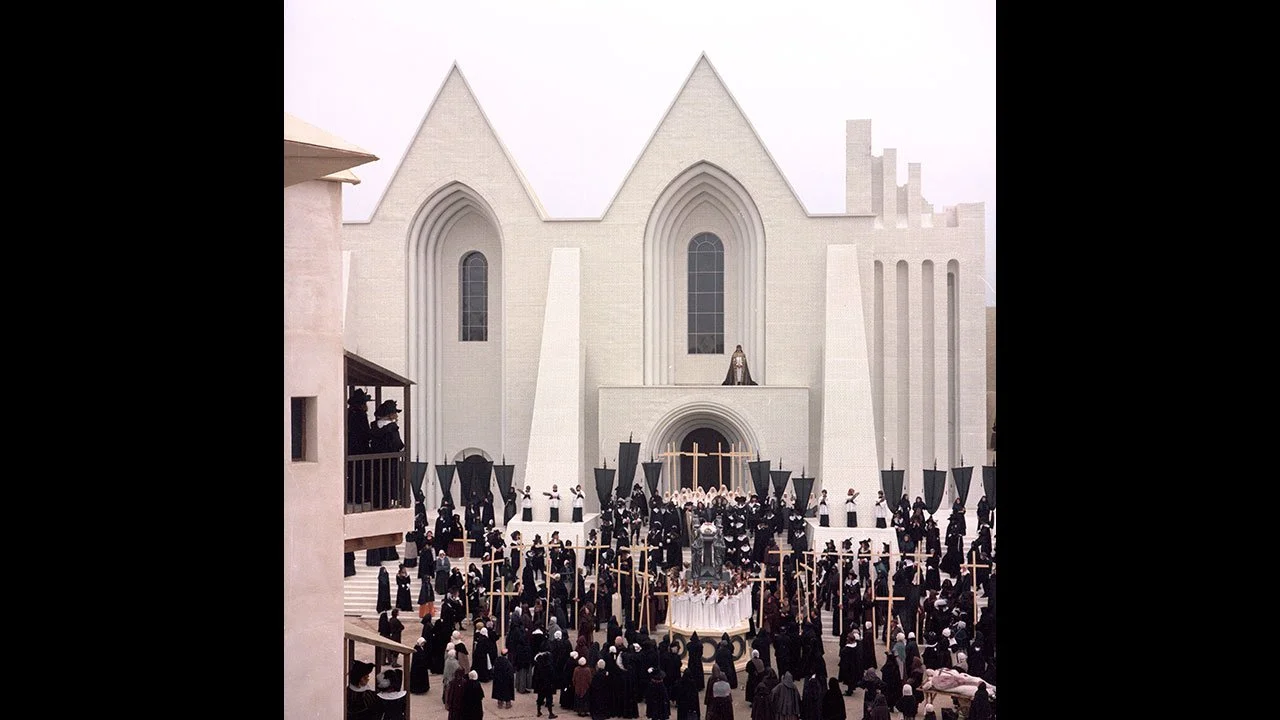
The Loudun set, built from scratch for the film. Production design by Derek Jarman. Still from The Devils (1971), Warner Bros.
What it's really about
Mass psychosis. A whole town believes an idea, and it catches. The scene that sums it up for me is when Louis XIII produces a vial that supposedly holds the blood of Christ and offers it to be used against the devil. The exorcist handles it with total reverence and walks around trying to heal people with it. Then the king shows him the box is empty.
That's the movie. Greedy people will do anything to get an obstacle out of the way, and the crimes they pin on an innocent man are nothing next to what they do to him. It's also a flipped Tommy. Russell's rock opera was about a rock star who becomes a messiah. This is about a priest who's treated like a rock star and ends up condemned.
Should you watch it?
Yes, with a warning. It's a fascinating film, but it isn't an easy one. If you're okay with weird, unsettling and deliberately blasphemous, you're in for a wild ride.
I'd own it on 4K just for how it looks. Will I rewatch it often? Hard to say. But I said that and a month later I was still thinking about it, which is usually the sign of a film that did its job. If it's playing near you, see it on a big screen with a good crowd.
The restored cut opened in North American theaters on October 16 for a limited run, and the UK release through BFI Distribution follows on October 30. Check your local listings.
Watch my full video review of The Devils on the Film Dweeb YouTube channel, and if you like this kind of thing, subscribe for more reviews and deep dives.