

I was working as a film buyer for a retail chain when the Warner Bros. rep came in with a free pass and a disclaimer. The movie was V for Vendetta. It was opening week, 2006. He slid the pass across the desk and said something I've never forgotten: "It's a hard sell. It won't do well in theaters. But in ten years, people are going to talk about it the same way they talk about Blade Runner."
He was right.
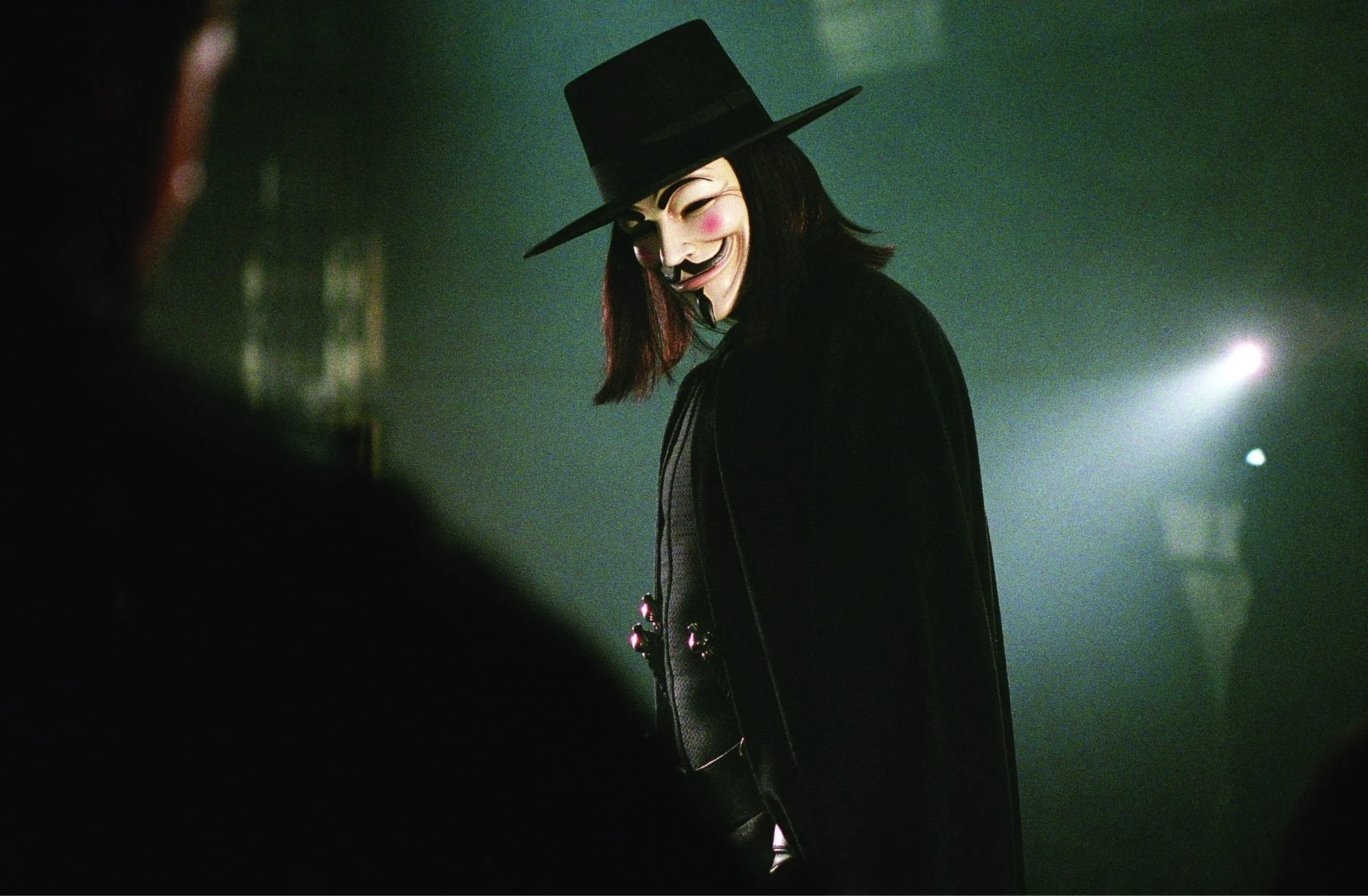
I went and saw it. Then I went and found the graphic novel. And that's when things got interesting, because the two versions of V for Vendetta are telling the same story in noticeably different ways, and understanding those differences says a lot about both of them.
What the graphic novel actually is
Before you can talk about what changed, it helps to know what Alan Moore and David Lloyd were making in the first place.
V for Vendetta started in 1982, serialized in a British anthology magazine called Warrior. Margaret Thatcher was Prime Minister. The country was in the middle of a recession, the miners' strikes were coming, and Moore was watching what he saw as a slide toward authoritarianism with real alarm. This wasn't a superhero book. It was a political book wearing the costume of a superhero book; a deliberate, angry response to the political moment Moore was living in.
If you ever saw it in a comic shop back in the day, it was under the Vertigo imprint, DC's adult label, the one that carried Sandman and Preacher and other work that wasn't meant for kids. That imprint was a signal. This was dense, layered, morally complicated material. Moore's V isn't just a freedom fighter; he's also a manipulator, a torturer, and a man whose methods raise real questions about whether the ends justify the means.
AFFILIATE: V for Vendetta — 4K Blu Ray
The scene that almost didn't make it
Here's something most people don't know: Warner Bros. wanted to cut the Valerie sequence.
Valerie Page, the lesbian actress whose letter V passes to Evey during her imprisonment, is the emotional core of both the graphic novel and the film. Her story is what transforms Evey. It's what connects V's past to Evey's present. It's the sequence that earns the ending.
The studio didn't see it that way. Director James McTeigue fought to keep it in. He won.
It's worth sitting with that for a second. The most human moment in the entire film, the sequence that gives the whole thing its moral weight, was nearly removed by the people financing it. McTeigue understood what the studio apparently didn't: without Valerie, you just have a guy in a mask blowing things up. With her, you have something that actually means something.
Valerie exists in both versions, and in both she serves the same function. She's proof that dignity is possible even when a system is designed to destroy it.
The subtext hiding in plain sight
This is the part that tends to surprise people who've only seen the film.
Larkhill, the detention and experimentation camp where V was held, wasn't a generic prison. In the world of the graphic novel, it held what the Norsefire regime classified as "degenerates." That was the period term. It meant gay people. Larkhill was, in effect, a concentration camp specifically targeting sexual minorities, along with other groups the regime found undesirable.
V was held in the cell next to Valerie's.
The film never explicitly states who V was before Larkhill. It never tells you his name, his history, what he was arrested for. That's not an oversight; it's the point. Film critic Tony Williams, writing in CineAction magazine in 2006, argued that V "represents a group rather than an individual." The mask isn't just a disguise. It's a statement about collective identity. V is everyone Larkhill was built to destroy.
You don't need the film to spell it out. The implication is sitting right there in where he was, and who he was next to.
What the film added
Here's where the "they watered it down" argument falls apart.
Gordon Dietrich, played by Stephen Fry, doesn't exist in the graphic novel. He's a film invention. And what the film does with him is actually an expansion of the graphic novel's queer themes, not a reduction of them.
Dietrich is a television personality living a carefully constructed public life that has nothing to do with who he actually is. His secret room contains banned art, a Quran, and evidence of the person he's had to hide to survive. He invites "young and attractive ladies" home because that's what's expected of him in a society that would have him imprisoned or killed for the truth. He wears, as Williams puts it, "the mask of a heterosexual swinger" — a survival mechanism in what the film portrays as a rigidly enforced social order.
When he finally shows Evey who he really is, it costs him everything.
The film didn't remove the queer dimension of Moore's source material. In some ways it made it more explicit, and more personal.
What genuinely got cut
That said, there are real differences worth knowing about.
In the graphic novel, Evey is a teenager and a sex worker. Not because Moore was being gratuitous, but because it changes the power dynamic of her relationship with V entirely. She's not a young professional with a TV job who gets pulled into something dangerous. She's a kid with no options, trying to survive in the worst possible way, in a society designed to chew people like her up. What V represents to her, and what his manipulation of her means, carries a different moral weight when you understand that context.
Inspector Finch's investigation of Larkhill also takes a different form in the graphic novel. At one point he takes LSD to psychically inhabit the ruins of the camp, an attempt to understand through altered consciousness what happened there. It's one of the strangest sequences Moore ever wrote and one of the most effective. The film replaced this with something more procedural. You lose the sense that the past isn't just history; it's something you have to experience to comprehend.
And V in the graphic novel is more explicitly a hacker and systems saboteur, someone who attacks the regime through its infrastructure rather than through dramatic confrontations. The film leans harder into the theatrical, the symbolic, the spectacular. That's a legitimate creative choice, but it shifts V from a practical revolutionary into more of a mythic figure.
So which one is better?
Neither. Wrong question.
The graphic novel is a product of 1982 Britain, specific, angry, rooted in a particular political moment. The film is a product of 2005 America, broader, more allegorical, designed to speak to a wider audience about different anxieties. Both work on their own terms. Both have something the other doesn't.
The Warner Bros. rep who handed me that free pass knew he had something unusual on his hands. He just couldn't sell it to a Friday night crowd. Twenty years on, the Guy Fawkes mask has become one of the most recognizable political symbols on the planet, used in protests from Wall Street to Hong Kong to Cairo. Alan Moore famously hates that. But it proves his point better than any essay could.
Read the graphic novel. Watch the film. They're asking the same questions in different languages. You don't have to choose.
Further reading: Tony Williams, "Assessing V for Vendetta," CineAction No. 70, 2006, pp. 16–23.