

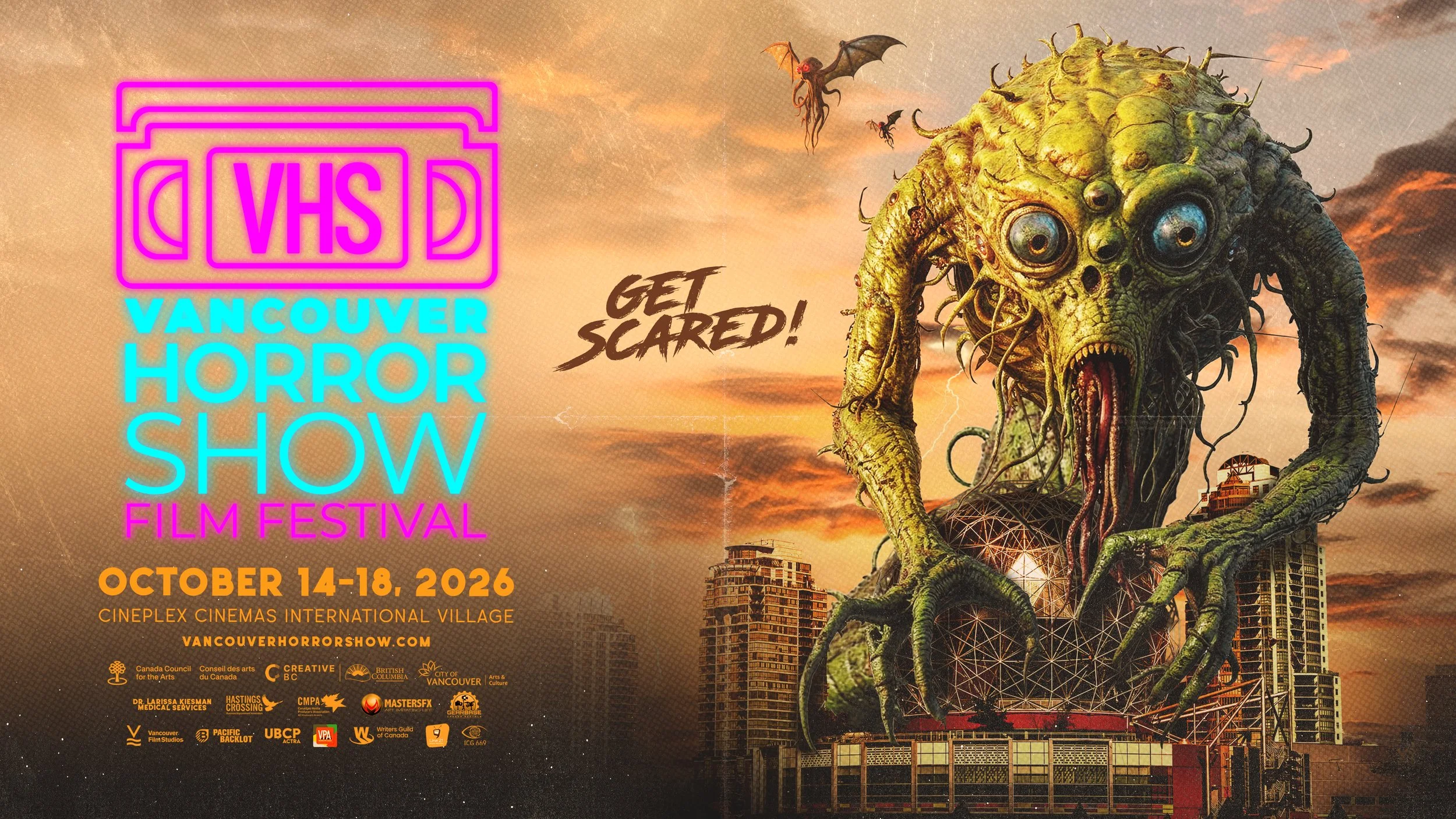
The Vancouver Horror Show ran October 14 to 18 this year, and I attended as press. It's a small, horror-only festival that's been going for around seven or eight years, and it leans hard into Western Canadian filmmakers, retro screenings and long Q&As where the talent is actually around to talk. The atmosphere is relaxed, and the venue, Cineplex Cinemas International Village downtown by the stadiums (Tinseltown, if you remember it from the '90s), is better kept than you'd expect.
I caught four features, a bit fewer than I'd planned. I came in tired from the Vancouver International Film Festival the week before, and I was trying to keep the channel moving at the same time. But I saw enough to say it's worth your time, and enough to see a pattern.
Trick or Treat
Already covered, so I won't repeat myself. Read my Trick 'r Treat anniversary screening recap here.
Ithaqua
Ithaqua took Best Picture, Best Director, Best Supporting Actor, Best Cinematography and Best Sound, and it earned them. It's directed by Casey Walker and set at a remote fort in a winter where the supply wagons never arrive. The garrison is starving. An American soldier (Luke Hemsworth) who is quietly in love with a local Native woman (Leenah Robinson) goes out foraging, while the magistrate (Michael Pitt) looks suspiciously well fed. Out in the bush, the foragers find a slaughtered village, and one of their party starts showing symptoms that aren't scurvy.
It's built on a legend about a vengeful spirit that possesses people and drives them toward cannibalism. That's a story about greed as much as hunger, and the film doesn't forget it. I won't spoil where it goes. The cold is real, which matters more than you'd think. It was shot at a fort in Thunder Bay, Ontario, and you can see it on the actors' faces.
Full review coming Wednesday, October 28.
Ancestral Beasts
This is not your standard horror movie. Morgan Holmstrom plays an urban-raised Métis woman who returns, alone, to the family home in a Manitoba Métis community, haunted by what happened to her mother. The scenes in the house are properly frightening, the kind of thing that works on anyone who has spent a night alone in an old house. But it doesn't go for jump scares or turn into a gore fest. It goes into the psychology of the character, and the horror is the kind that gets passed down through generations. It's heartbreaking to watch, and the performances, Holmstrom's especially, are spectacular.
It's an Indigenous production from top to bottom, made with the help of the Indigenous Screen Office, and shot in Manitoba. Full review coming Wednesday, November 4.
Encryption
A locally made found-footage anthology. A man and his niece find a set of encrypted files, and each one they decrypt turns out to be its own paranormal story: aliens, Sasquatch and so on. It screened at the festival as a world premiere.
The Indigenous Filmmakers Panel
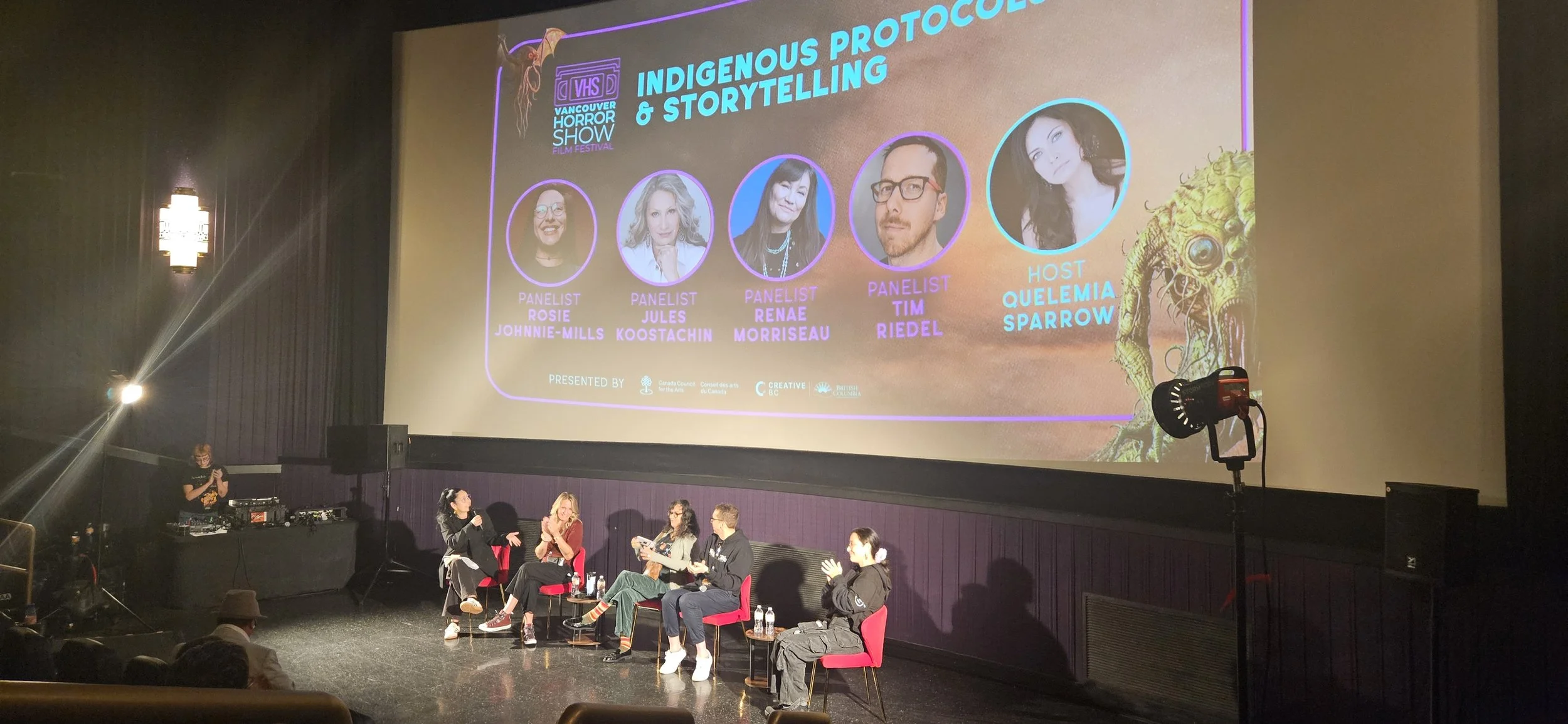
The Indigenous Protocols & Storytelling panel at the Vancouver Horror Show.
The panel before Ancestral Beasts, Indigenous Protocols & Storytelling, was the highlight of the festival for me. Hosted by Quelemia Sparrow, it brought together Rosie Johnnie-Mills, Jules Koostachin, Renae Morriseau and Tim Riedel, to talk about how making a film with Indigenous communities follows different protocols from a standard set. In documentary situations especially, such as people in the middle of ceremony, there are things you simply don't film. They also talked about how hard that is when the crew doesn't understand it, and about the scary stories they grew up with. The similarities between those stories across different nations were striking.
It ties into something I've noticed for years. Indie horror has long borrowed Native American mythology without doing any research, just as zombies come out of Haitian folklore and Stephen King leaned heavily on Native ideas. Nobody asked where those stories came from. This year the people who carry them were in the room to answer, and the festival was open to that conversation. It's the same trend I saw at VIFF the week before, which had the most Indigenous films in its history. Organizations like the Indigenous Screen Office and other initiatives are helping more projects get made, and they're not exploitative.
Final Thoughts
Independent horror is still the genre where filmmakers get their start, and this festival is a good example of why. It's relaxed, it's local, and the filmmakers are right there. I'll be back next year, and I'd recommend supporting it, especially for the way it lets filmmakers work without being exploited.
Long live independent horror.