

Most people who have seen Michelangelo Antonioni's Blow-Up remember one scene before they remember the plot. A photographer in a London studio, camera clicking, circling a tall woman in a black dress who arches and twists on the floor while he shouts encouragement and finally straddles her for the last frames. Then he walks off and flops onto a couch, spent, and she is left lying there. The woman was Veruschka, playing herself. She has died at 87.
Who She Was
Her death was reported Wednesday, confirmed to Germany's Bild newspaper, according to Variety and Deadline. Vogue reported that she died at home.
Born Vera Gottliebe Anna Gräfin von Lehndorff-Steinort in East Prussia in 1939, she came from an old aristocratic family. Her father, Heinrich von Lehndorff, joined the German resistance and was executed when she was five for his part in the July 1944 plot to assassinate Hitler. She was discovered as an art student in Florence, met Eileen Ford in Paris, and moved to New York. By the mid-'60s she was one of the most photographed women in the world, standing over six feet tall, working with Richard Avedon, Irving Penn, David Bailey and Peter Beard, and landing a long run of Vogue covers. She is often called the first German supermodel.
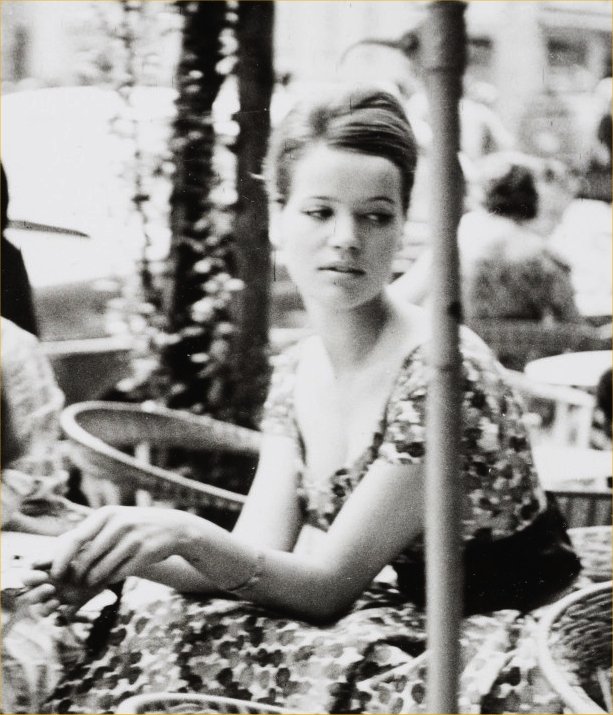
Veruschka at Café Cadore on Leopoldstraße, Munich, 1960. Photo: Barbara Niggl Radloff / Münchner Stadtmuseum, Wikimedia Commons, CC BY-SA 4.0. Featured image: Veruschka at the Berlin Film Festival, 2013. Photo: Siebbi / Wikimedia Commons, CC BY 3.0.
Five Minutes That Defined a Film
Blow-Up (1966) was Antonioni's first English-language film and it went on to win the top prize at Cannes in 1967. David Hemmings plays Thomas, a bored fashion photographer who may or may not have photographed a murder in a park. The movie is about looking: what a camera catches, what it misses, and whether blowing an image up makes it truer or just grainier.
Veruschka is on screen for only a few minutes, but her shoot is the film's thesis in miniature. It is staged like a seduction and played like a performance, and it ends with nothing. Thomas gets the pictures and walks away bored. Antonioni is showing you a man who can only feel anything through a lens, and Veruschka, by playing a version of her real self, makes the scene feel like a document of Swinging London rather than a re-creation of it. She turns up again later at a pot-soaked party, where Thomas, who thought she had gone to Paris, gets a deadpan reply that she is in Paris. It is one of the film's best jokes about a world where nobody is quite where they say they are.
If you've never seen it, (AFFILIATE: Blow-Up Criterion Collection Blu-ray - the film's best home video edition, with extras on its making is the way to fix that.)
The Screen Career After
Movies were never her main job, but she kept coming back to them. She appeared in Franc Roddam's The Bride (1985), and a younger generation of viewers has seen her without knowing it: she sits at the high-stakes poker table in Casino Royale (2006), one of only two women playing against Daniel Craig's Bond and Le Chiffre. With Bond casting back in the news, Robert Pattinson's reported casting included, that cameo is a fun reminder of how far her image travelled.
The Film Dweeb Take
Plenty of models have been in movies. Very few have ended up as a permanent piece of film grammar. The Blow-Up shoot has been copied, quoted and parodied for almost 60 years, and the reason it still works is that Veruschka never plays it as a cameo. She plays it straight, as work, which is exactly what makes Hemmings' boredom afterward so chilling. Antonioni needed someone who could be the most looked-at woman in the world and still seem untouched by it. He cast the real thing.