

VIFF Just Announced Its 2026 Lineup, and It's a Showcase of How Films Get Made Now
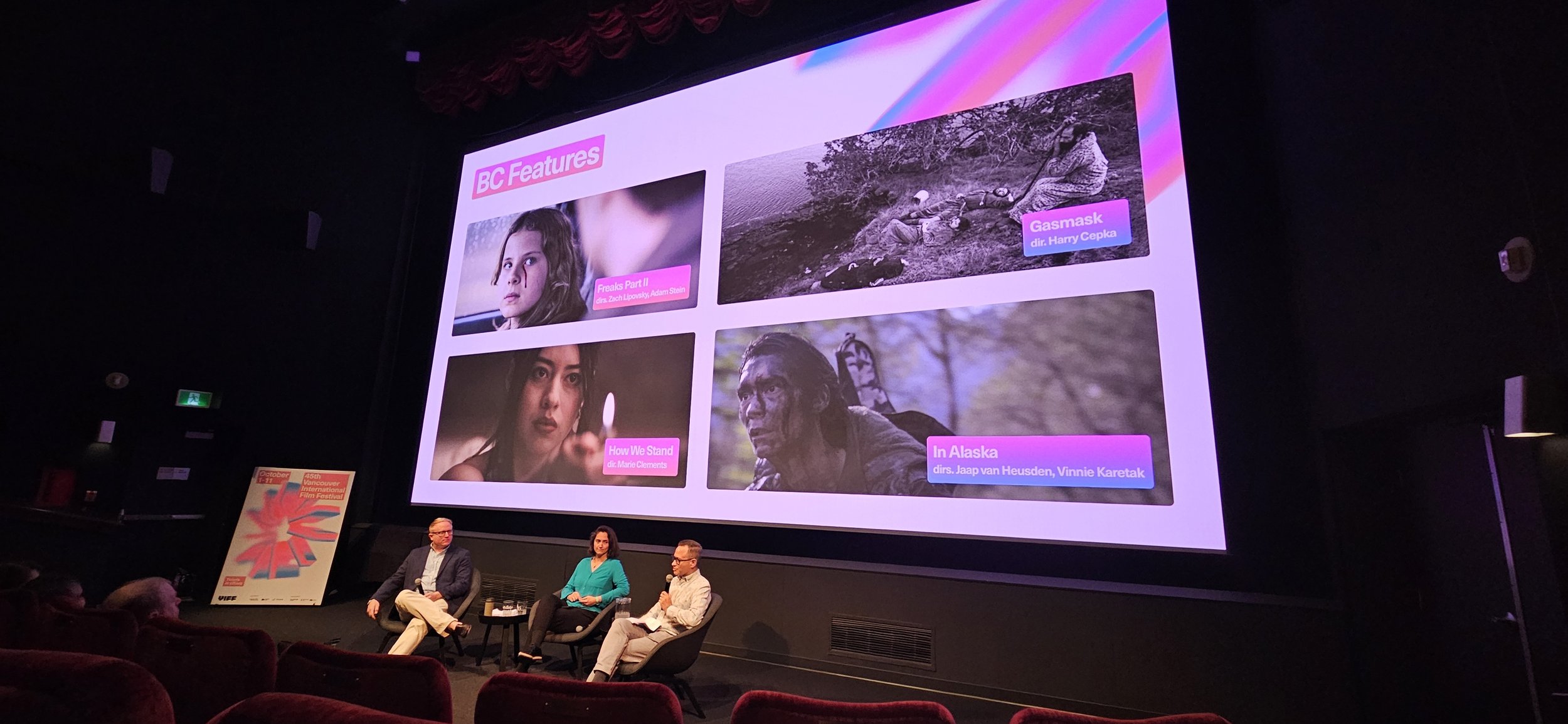
Kyle Fostner, Ana Belén Asfura and Curtis Woloschuk
The Vancouver International Film Festival dropped its 45th edition lineup today, and one thing became clear watching the trailers roll: the movies filling this slate are increasingly not "made" by any one country. They're stitched together across several.
That's not a small trend. Outside the U.S., a purely domestic production, one country developing, financing, and shooting a film on its own, is becoming the exception rather than the rule. International co-production has become less of a stylistic choice and more of a survival strategy. Filmmakers in uncertain economic and political climates are pooling resources, casts, and funding across borders to get projects made at all. And a handful of this year's titles wear that plainly: McDonagh's Wild Horse Nine is a UK/USA/Chile production. Kai Stänicke's Trial of Hein came together through Germany's Tamtam Film alongside Lupa Film and ZDF. These aren't outliers, they're closer to the new normal.
Festivals like VIFF matter more in that environment, not less. They're one of the few places where these internationally assembled films actually find an audience and a spotlight before wider release, and that fact showed up throughout today's programming.
The bookends still make a good starting point. Opening night belongs to Jesse Eisenberg's The Debut, a musical comedy where Julianne Moore plays a mild-mannered housewife who gets cast in a local production and slowly, unnervingly loses herself in the role under the sway of Paul Giamatti's "biggest name in New Jersey community theatre." Closing night is Martin McDonagh's Wild Horse Nine, with John Malkovich and Sam Rockwell as CIA officers dispatched to Easter Island right before the 1973 Chilean coup, and Steve Buscemi as their bureau chief.
The rest of the slate carries that same international thread. A focus on new German cinema centers Trial of Hein, Kai Stänicke's Canadian premiere and a Berlinale Teddy Award winner, about a man who returns to his isolated island village after 14 years and finds nobody willing to confirm he's actually who he says he is. Tony Gilroy's Behemoth!, his first feature since 2012's The Bourne Legacy, starring Pedro Pascal as a cellist looking back on a messy life, gets its Canadian premiere too. And two Cannes winners are landing here: Cristian Mungiu's Palme d'Or-winning Fjord (a Romanian-Norwegian production) and Ryûsuke Hamaguchi's All of a Sudden.
The numbers back up the ambition. This year's edition features 162 films from 76 countries, with over 50 documentaries making it the second-biggest non-fiction lineup of any festival in North America. Also notable: 19 Indigenous films in the program, the largest slate VIFF has ever shown. That includes BC Features like Marie Clements' How We Stand, Zach Lipovsky and Adam Stein's Freaks Part II, and In Alaska, co-directed by Jaap van Heusden and Vinnie Karetak, all of which got their moment on the big screen at today's event.
And there's an infrastructure story here too. VIFF used the event to expand on its Institute for the Moving Image, which organizers were careful to describe as not a film school but an industry resource, somewhere working filmmakers can be mentored and have an actual workspace. Given everything above, that reads less like a nice to have and more like the local piece of the same survival puzzle: build the support system now so B.C. and Canadian talent have a foothold in a production landscape that's only getting more collaborative and more competitive.
That same idea kept surfacing across the trailers shown today: characters finding their way home, against a backdrop of doubt, with something holding them together anyway. Fitting, for a festival built this year around films that only exist because people from different countries decided to make them together.
VIFF runs October 1–11. Tickets go on sale to the public August 27th.