

The Odyssey Review: Nolan's Practical-Effects Epic Is a Beautiful, Uneven Trip
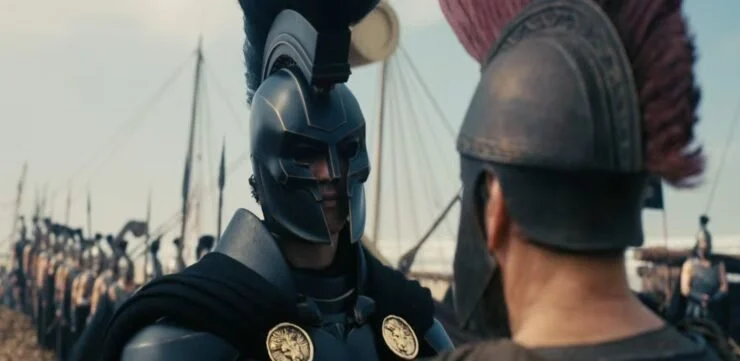
I saw The Odyssey today in true 70mm, on celluloid, projected the way movies used to be projected before that was a novelty instead of the default. The first few minutes were a little shaky, like the sprockets needed a minute to remember how to do their job again. Then it settled in, and for the next two-plus hours I watched what might be one of the last big studio movies that's almost entirely practical, in-camera, done the hard way. It looks incredible. And I want to say up front, before I get into the rough patches: I liked this movie. It's genuinely epic, in the way that word barely gets used correctly anymore.
Most of the conversation around this film so far has been about controversy, and mostly about Elon, honestly. I want to set that aside for now and talk about the movie itself, because there's a lot going on in it, more than the discourse is giving it credit for, and more than I expected going in.
What Nolan Gets Right
Hoyte van Hoytema shoots this the way he shot Dunkirk, chasing natural light, letting it do the emotional work instead of hiding behind digital sheen. There's a real contrast built into how the film is composed. You get big grand-scope shots of the ocean and certain beach sequences, and then a lot of the dramatic material, mostly characters talking through what they've lost, is shot in tight medium close-ups with a shallow depth of field. Then Ithaca (the home Odysseus is trying to get back to) is shot with a deeper focus, everything in the frame sharp and present, like the movie itself is telling you this is the real, stable place, even when the story keeps cutting away from it.
The Cyclops cave sequence is the standout, genuinely one of the most incredible things I've seen in a theater in a long time. There were moments in this movie where I just sat there thinking, this is one of the most amazing things I've ever watched on a screen. It's the kind of practical-effects filmmaking that doesn't really get made anymore, and it earns every bit of scale it goes for. The music underneath it is doing a lot of work too. It's intense in a way that matches the visuals rather than fighting them, which isn't always true of Nolan's scores.
Where It Stumbles
Nolan has a sound mix problem, and it's not new. Tenet had the same issue, to the point where I needed subtitles on 4K Blu-ray just to follow the dialogue. The Odyssey opens the same way. The first thirty to forty-five minutes, establishing characters and backstory before the Trojan War material kicks in, are a slog to parse dialogue-wise. The one performer who's consistently intelligible is Travis Scott, delivering exposition to a room like it's his day job, because, in a sense, it is.
Once Odysseus (Matt Damon) actually sets out for home, the movie locks in. Nolan's time-jump structure, cutting between the voyage, the lead-up to the Trojan Horse, and Penelope waiting back in Ithaca, gets a little tangled in places, but you catch the gist even when the mechanics are murky. What I noticed watching it is that Nolan gets visibly, almost gleefully excited whenever the scope broadens and the action kicks in. It happens in Tenet, it happens in Inception, and it happens here. The action sequences have an energy the dramatic scenes don't always match, and when he settles into the quieter character beats, there's a sameness to how everyone talks, the same clipped, urgent cadence, no matter who's speaking. It's a tendency he shares with someone like Nicolas Winding Refn, where every character ends up sounding like a version of the director rather than a distinct person.
It's worth noting Nolan reportedly screened The Last Temptation of Christ for cast and crew as a tonal reference going in. That's an intimate, spiritual character study about a man wrestling with who he is and what he's meant to be. The Odyssey isn't that movie. It's much bigger, much louder, and it doesn't really carry that same intimacy through, but the DNA of that question, the identity crisis, the crisis of faith, is still there underneath the spectacle, even if the scale sometimes drowns it out. Compare it to something like Nolan's approach in Interstellar, where he played it safe with the crop blight and never quite said the word "climate change" out loud. Here, with the casting choices and the mythological framing, he's edging a lot closer to actually taking a stance, whether or not the finished film fully commits to it.
The Real Story Here
Strip away the mythology and what you actually have is a movie about a soldier with PTSD. Odysseus comes home from Troy and he's not the man who left. For a long stretch of the film he's stuck on some beach with Charlize Theron's character, and he has amnesia, because he's been consuming lotus flowers meant to soothe his soul. It works, in the sense that it numbs him just enough to keep functioning. But it also means he can't remember what happened to him, or what he did over there. As he starts to cut back, the memory comes flooding back, and along with it, the realization of how long he's actually been away from home, and how much of himself he lost getting there.
That's the engine of the whole film. The same hardness that let him survive the war, the same willingness to break the rules of the gods to do it, is exactly what he needs to save his family once he's home. It's a man dealing with what he did in combat, forced to use that same broken part of himself to protect the people he came back for. He's asking, in the middle of a three-thousand-year-old myth, the most modern question there is: am I actually the good guy here? Not about Troy specifically. About a system, an empire, looking honestly at what it did to win, and realizing everyone else is now afraid of what it's capable of doing again. That fear spreads. He set it off, and now he has to live inside what he started, and figure out how to pass something better down to his own son instead.
What This Movie Is Really Reacting To
Every era's blockbusters end up telling you what that era is actually afraid of, whether the filmmakers mean to or not. Post-9/11 American cinema was obsessed with cities getting leveled: disaster movies, superhero films where entire skylines came down, the anxiety of collapse made literal and enormous. Post-COVID, the collective nervous system shifted inward, toward body horror, isolation, the fear of what's happening inside you that you can't see or control.
The Odyssey feels like it's sitting at the start of whatever comes next: stories where the anxiety isn't "will we survive this" but "did we do something unforgivable to survive." A lot of Western audiences right now are sitting with genuinely uncomfortable questions about power, war, and complicity, questions that don't have clean answers. Nolan didn't invent that discomfort, but he's clearly tapping it, wrapping a three-thousand-year-old myth around a very current identity crisis: what happens when the hero looks back at what winning cost, and doesn't like what he sees.
The Controversy Was Never Separate From the Movie
A lot of the pre-release noise treated the casting (Zendaya, widely assumed incorrectly to be playing Athena, Elliot Page as part of the Achilles storyline, Helen of Troy cast Black) as controversy adjacent to the film, something to get past to talk about the "real" movie. Having seen it, I don't think that holds up. Watch what actually happens to those characters: Helen is a pawn, an excuse manufactured for a war that was never really about her. Zendaya's character gets used the same way. The people who assumed casting decisions before seeing a frame of the film were, in a strange way, proving the movie's point for it, a story about people getting flattened into symbols by forces bigger than them, playing out in real time in the discourse around the movie itself.
I think Nolan knew the backlash was coming. I don't think he was trying to dodge it. I think he built a movie that's partly about how myths get flattened into simple stories by the people retelling them, and then watched that exact thing happen to his own film before anyone had seen a frame of it.
Verdict
I liked this movie. I want to say that plainly, because everything above might read like a list of complaints, and it isn't meant to. The Odyssey is a roller coaster. It starts slow, it really picks up, then it drops again, then it picks up harder than before. There are stretches where you're just quietly immersed in this old, crumbling belief system, and then the next thing you know you're in the middle of the biggest sequence you've seen all year. It's a strange, surreal balance, and it does run long. Out of everything Nolan's made, this is the one where I caught myself waiting for it to pick back up more than once, but that's a small price for a movie this ambitious. That's not really a knock. It's a movie that wants you to sit in the quiet parts so the big parts land harder, and when it lands, it lands about as hard as movies get.
It's uneven, and the first act asks for patience it doesn't always reward. But it's also one of the last movies of its kind you're likely to see: massive, practical, in-camera, betting everything on real light and real scale instead of a green screen, and it mostly earns that bet. If you can see it in 70mm, see it that way. It's not Nolan's tightest film, but it might be his most sincere one, an actual attempt at asking a question he doesn't have a clean answer to, and by the end, standing in the mirror with Odysseus, neither do you. That ambition is worth celebrating on its own, and this is a movie I'll be thinking about for a while.
If you want the source material this is all built on, [AFFILIATE: Homer's The Odyssey, Emily Wilson translation, the modern-language approach mirrors what Nolan's doing tonally with an ancient story] is the version worth reading alongside the film.