

Nine minutes of every hour. That is how much of your time on Paramount+ now goes to ads, up from about 7.9 minutes in January, according to Ampere Analysis data reported by Android Authority. And since October 6, Paramount+ shares a parent company with HBO Max, Warner Bros. and CNN.
I opened this month's Film Dweeb Podcast with those two facts because they belong together. Here's why.
Also listen on: Spotify | Apple Podcasts | YouTube
The deal, in numbers
Paramount's takeover of Warner Bros. Discovery closed on October 6 at $31 a share. The equity was valued at $81 billion, roughly $110 billion once you count debt. The combined company now goes by Skydance, led by David Ellison with Ynon Kreiz as co-CEO.
To get regulators and 12 state attorneys general on board, the company agreed to at least 30 theatrical releases a year, $1.5 billion in domestic production over five years, and a five-year pause on CBS layoffs. HBO Max and Paramount+, with roughly 200 million subscribers between them, are expected to merge into one platform "in the coming years." There is no date, no name and no pricing yet.
Here's the part worth sitting with. The company also carries roughly $80 billion in debt, and its leaders have already warned staff about "difficult decisions." A floor of 30 films a year is a promise to fill theaters, not a promise to make good movies. The first test came fast: Clayface, a Warner DC release, opened at number one with $24.0 million, then fell about 57% the following weekend.
The ad load keeps climbing
Between January and August, average ad loads across the major US streamers rose 18%. Paramount+ went from 7.87 to 9.01 ad minutes per hour. Netflix went from 1.40 to 2.44, a 74% jump, though it still has the lightest load. Prime Video was the only major service to cut, from 2.78 to 2.60.
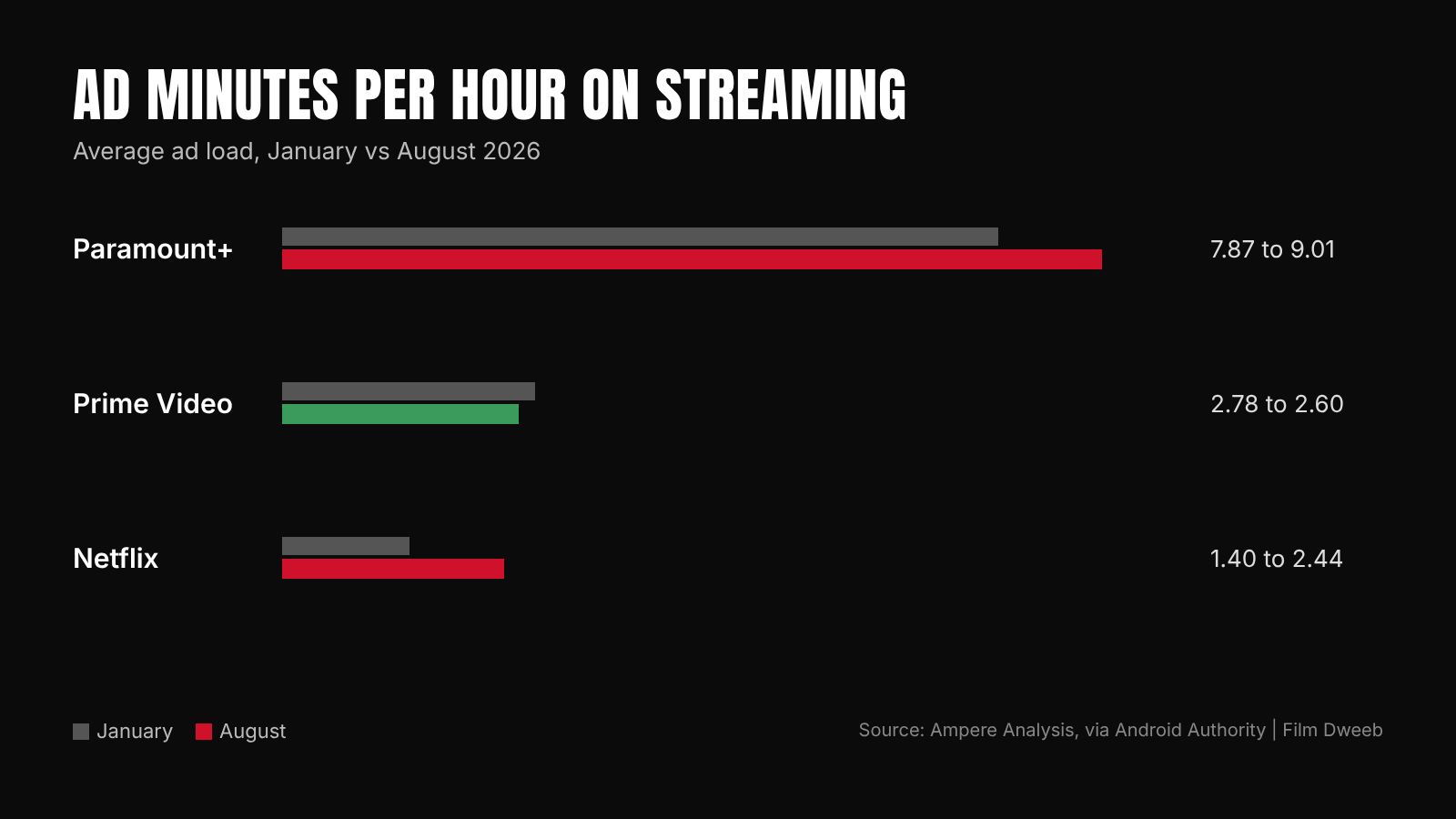
Average ad minutes per hour, January vs August 2026. Source: Ampere Analysis, via Android Authority.
One analyst's line stuck with me: once ad tiers reach scale, they are more lucrative than ad-free ones. The ad tier stopped being the cheap alternative a while ago. It became the business.
I've noticed it on my own Amazon account, where ads land in the exact spots where the original broadcast cut to commercials. It's like watching the show as it aired, minus the DVR. Theaters did this first. Nobody asked for the pre-show, but you've already bought the seat. Streaming rebuilt that at home: you've paid, you're settled, and the break comes whether you like it or not.
What a disc gets you
A disc has no ad load. It also has no licensing window, so it can't leave a service the month you wanted to watch it.
Warner's new Clockwork label is a good sign for people who care about this. It launched with Ken Russell's The Devils on 4K, which took in about $2.7 million on 350 screens in its first week, per The Numbers. Restore a classic, give it a proper release, then vault it. Whether Skydance keeps that going is an open question.
November is a good month to buy. Criterion's slate includes new 4K editions of Wild at Heart and Marie Antoinette, and if you've never seen The Right Stuff, the standard Blu-ray is an easy way to see a three-hour epic with no ad breaks: The Right Stuff on Blu-ray.
Fewer buyers
Disney, Amazon MGM, Netflix and now Skydance: the more studios become conglomerates, the fewer places a filmmaker can pitch. An odd, hard-to-market film has a smaller list of buyers than it did five years ago. My advice to independent filmmakers is the same as my advice to us: build your own audience and own as much of your work as you can.
Listen to the full episode
This month's podcast also covers October's box office, the streaming charts, what I watched at VIFF and the Vancouver Horror Show, and an AI-narrated deep dive on how Night of the Living Dead lost its copyright. The audio is on the Film Dweeb Podcast feed, and the video is for YouTube members.